In short
- Status (as checked 24 November 2026): the rebuilt Seiden (main hall) opened to the public at noon on 23 November 2026, seven years after the fire of 31 October 2019. The North Hall (Hokuden) and South Hall (Nanden) have not yet been rebuilt and no completion date has been published.
- Tickets: the paid area costs ¥1,000 for adults (¥760 high school, ¥370 primary and junior high, under-6 free). Seeing the inside of the Seiden needs a timed ticket booked online; the time slot costs nothing extra.
- Booking window: slots are released on the 1st of each month at 13:00 for the month two months ahead. Opening-day slots sold out; spare same-day slots, if any, can be bought from 15 minutes before the slot.
- Allow: 90 to 120 minutes for the whole route; about 15 minutes inside the hall, shoes off.
- Getting there: Yui Rail to Shuri Station, then about 15 minutes on foot.
Where things stand in November 2026
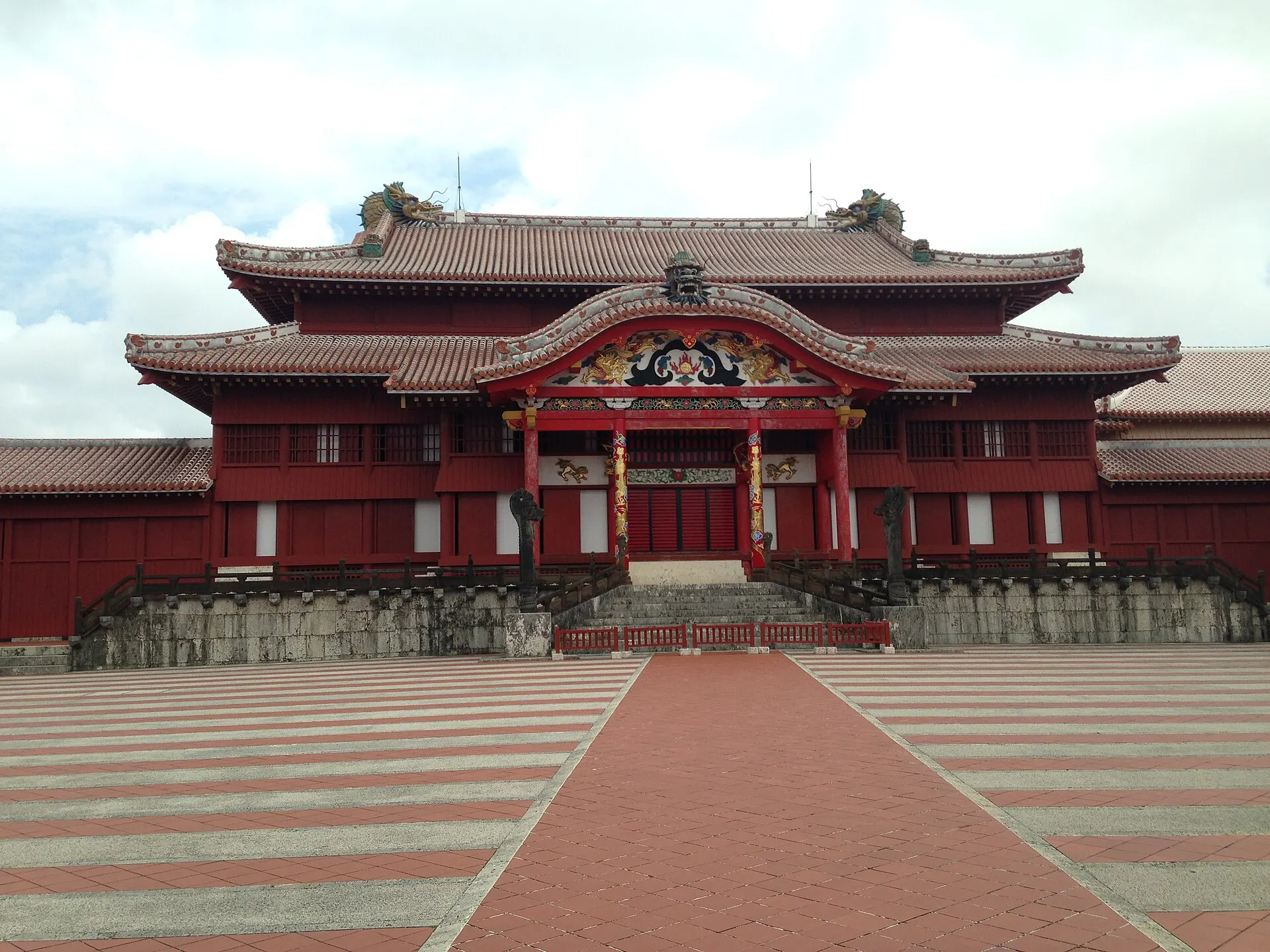
For seven years the main hall of Shuri Castle (首里城, Shurijō; Suigusuku in the Okinawan language) existed only as charred foundations under a huge temporary shed. That chapter closed on 22 November 2026 with a completion ceremony, and at noon on Monday 23 November, a public holiday, the first visitors walked into the new Seiden. The park's operator announced the opening on its official site on 21 November, and Ryukyu Shimpo reported the completion and the timed-entry system in the days before.
It is important to be precise about what is open. The Seiden, the three-storey vermilion hall that is the image of Shuri on every poster, is complete and its interior can be visited with a reservation. The other buildings around the central courtyard (the Una) that burned in 2019, including the North Hall (Hokuden) and the South Hall and Bandokoro (Nanden), are not yet rebuilt. The national government's 2020 reconstruction timetable put the Seiden first, with the North and South halls and other buildings to follow; at the time of checking, no completion date for those halls had been published. Ryukyu Shimpo reported that once the temporary roof enclosure over the Seiden is taken down, work will start on the corridors on either side of the hall.
Everything else in the castle park, including the gates, the stone walls, the viewpoints over Naha, the Kyō-no-uchi sacred area and the exhibition rooms, has been open throughout the rebuilding, and the paid area continues to be visited without a reservation. Only the Seiden interior needs a timed ticket.
- Seiden opened
- 23 November 2026, 12:00 (completion ceremony 22 November)
- Still being rebuilt
- North Hall, South Hall/Bandokoro and other courtyard buildings; no completion date published
- Adult ticket
- ¥1,000 (paid area; Seiden time slot at no extra charge)
- Hours, paid area
- Apr–Nov 8:30–19:00, Dec–Mar 8:30–18:00 (last entry 30 min before)
- Official site
- Shurijo Castle Park, oki-park.jp/shurijo
Booking the Seiden interior: how the timed tickets work
Inside the Seiden you see the throne hall on the upper floor and the ceremonial rooms where the king received envoys, much of it reconstructed from Meiji-era photographs, surveys and records. Because the hall is a wooden building with limited space, access is controlled by time slot.
Individual visitors book an entry ticket with Seiden interior reservation on the park's online ticket service (Webket). The time slot itself is free: the price is the normal paid-area admission. Slots for each month go on sale at 13:00 Japan time on the 1st day of the month two months earlier: tickets for February 2027 were released on 1 December 2026, March 2027 on 1 January 2027, and so on. The slots for opening day sold out in advance.
If a slot is not full, it can be bought on the day, either online up to 15 minutes before it starts or at the Hōshinmon ticket window. Holders of an annual pass and visitors who qualify for free admission must still reserve a slot. Group bookings (20 people or more) open in stages from 7 December 2026, partly by lottery.
Only tickets bought on Webket can be changed or refunded: you can move a reservation until the day before your visit, and refunds are possible up to two days before.
- Decide your date and check the release calendar: the 1st of the month, 13:00 Japan time, two months ahead.
- Book on the official Webket service linked from oki-park.jp/shurijo and choose a time slot (no extra fee).
- On the day, arrive at Shuri Station about 40–50 minutes before your slot (the official advice), or 30–50 minutes before if you come by car and park nearby.
- Pass the Hōshinmon gate and enter the Seiden within the slot. In the last slot (17:00 from December to March, 18:00 from April to November) you must pass Hōshinmon by 17:30 or 18:30.
- Take your shoes off inside: a bag for them is useful.
| Ticket | Individual | Group (20+) | Annual pass (general) |
|---|---|---|---|
| Adult | ¥1,000 | ¥800 | ¥2,000 |
| High school | ¥760 | ¥610 | ¥1,520 |
| Primary and junior high | ¥370 | ¥300 | ¥740 |
| Under 6 | Free | Free | — |
Opening hours and how long to allow
The castle park has a free area (the outer gates Kankaimon, Kyūkeimon and Keiseimon, the walls and lookouts) and a paid area (from the Hōshinmon gate inward, including the Seiden, the Sekoden hall and the Azana lookout tower).
The official estimate for the whole route, from the Shuri Mori-kan visitor centre to the end of the Seiden tour, is 90 to 120 minutes depending on crowds, of which about 15 minutes is inside the Seiden. With Shureimon, the Sonohyan-utaki stone gate and the Ryūtan pond outside, half a day is comfortable.
| Area | April–November | December–March |
|---|---|---|
| Free area (gates, walls) | 8:00–19:30 | 8:00–18:30 |
| Paid area incl. Seiden | 8:30–19:00 (last entry 18:30) | 8:30–18:00 (last entry 17:30) |
The castle that kept burning: a short history
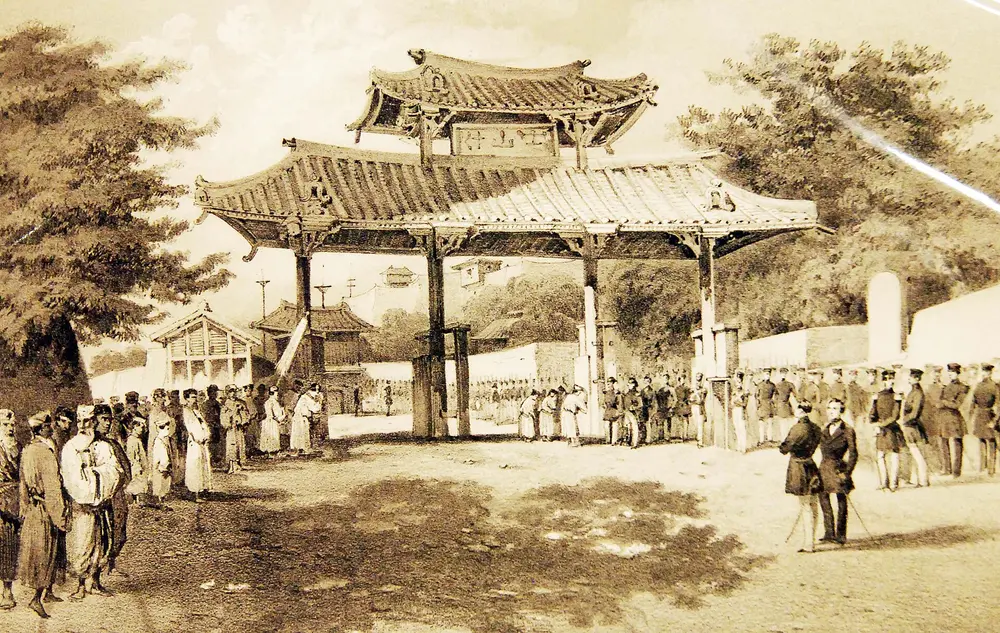
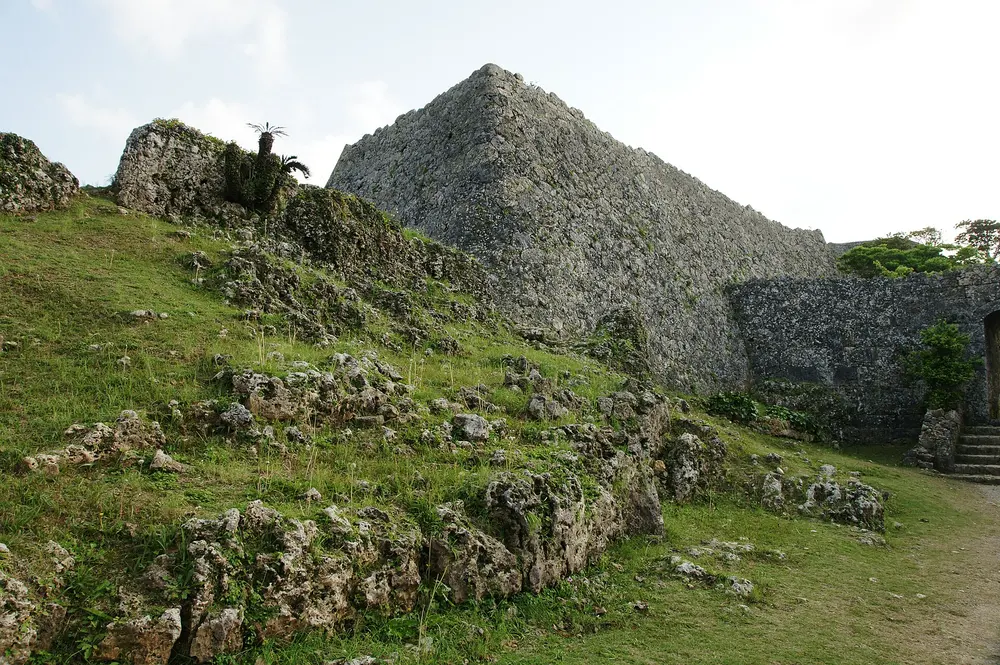
Shuri was the political, diplomatic and religious centre of the Ryukyu Kingdom for some 450 years. When Shō Hashi united the island's three rival kingdoms in 1429, Shuri became the royal seat, and the castle grew on a limestone hill above the port of Naha, with walls that curve along the ridge in the gusuku style rather than running in straight lines. Chinese envoys were received in its courtyard; officials stood in ranks on the striped paving of the Una; priestesses performed rites at the sacred groves inside the walls.
The Seiden burned at least three times in the kingdom's era, including in 1453, 1660 and 1709. The building rebuilt after 1709 survived into the modern era and is the model for both later reconstructions. After the kingdom was abolished in 1879 the last king, Shō Tai, was moved to Tokyo; the castle was used by the Japanese army and then by schools, and the decaying Seiden was saved from demolition in the 1920s, designated a National Treasure and restored in the early 1930s.
In 1945 the Japanese 32nd Army dug its headquarters into tunnels beneath the castle. American bombardment during the Battle of Okinawa destroyed everything above ground. After the war the University of the Ryukyus was built on the site, and only when it moved away was the ground cleared for the national government's reconstruction. The Seiden and the main courtyard buildings reopened on 3 November 1992, twenty years after Okinawa's return to Japan.
In 2000 the remains of Shuri Castle were inscribed by UNESCO as one of the nine Gusuku Sites and Related Properties of the Kingdom of Ryukyu. The inscription covers the original stone foundations and walls, not the reconstructed wooden buildings, which is why the 2019 fire did not affect the World Heritage status.
- 1429
Unification
Shō Hashi unites the island; Shuri becomes the royal capital.
- 1453, 1660, 1709
Fires
The Seiden burns and is rebuilt; the post-1709 hall is the model for today's reconstruction.
- 1879
End of the kingdom
Japan abolishes the Ryukyu Kingdom; the king leaves Shuri for Tokyo.
- 1925–1933
National Treasure
The Seiden is designated a National Treasure and restored.
- 1945
Destroyed in war
The 32nd Army's headquarters lies under the castle; the buildings are destroyed in the Battle of Okinawa.
- 1992
First reconstruction
The Seiden and courtyard halls reopen on 3 November.
- 2000
World Heritage
The castle remains become part of a UNESCO World Heritage property.
- 31 Oct 2019
Fire
Fire destroys the Seiden, North Hall, South Hall and other buildings.
- Nov 2022
Rebuilding starts
Ground-breaking for the new Seiden on 3 November 2022.
- 23 Nov 2026
Seiden reopens
Public opening at noon, with timed entry to the interior.
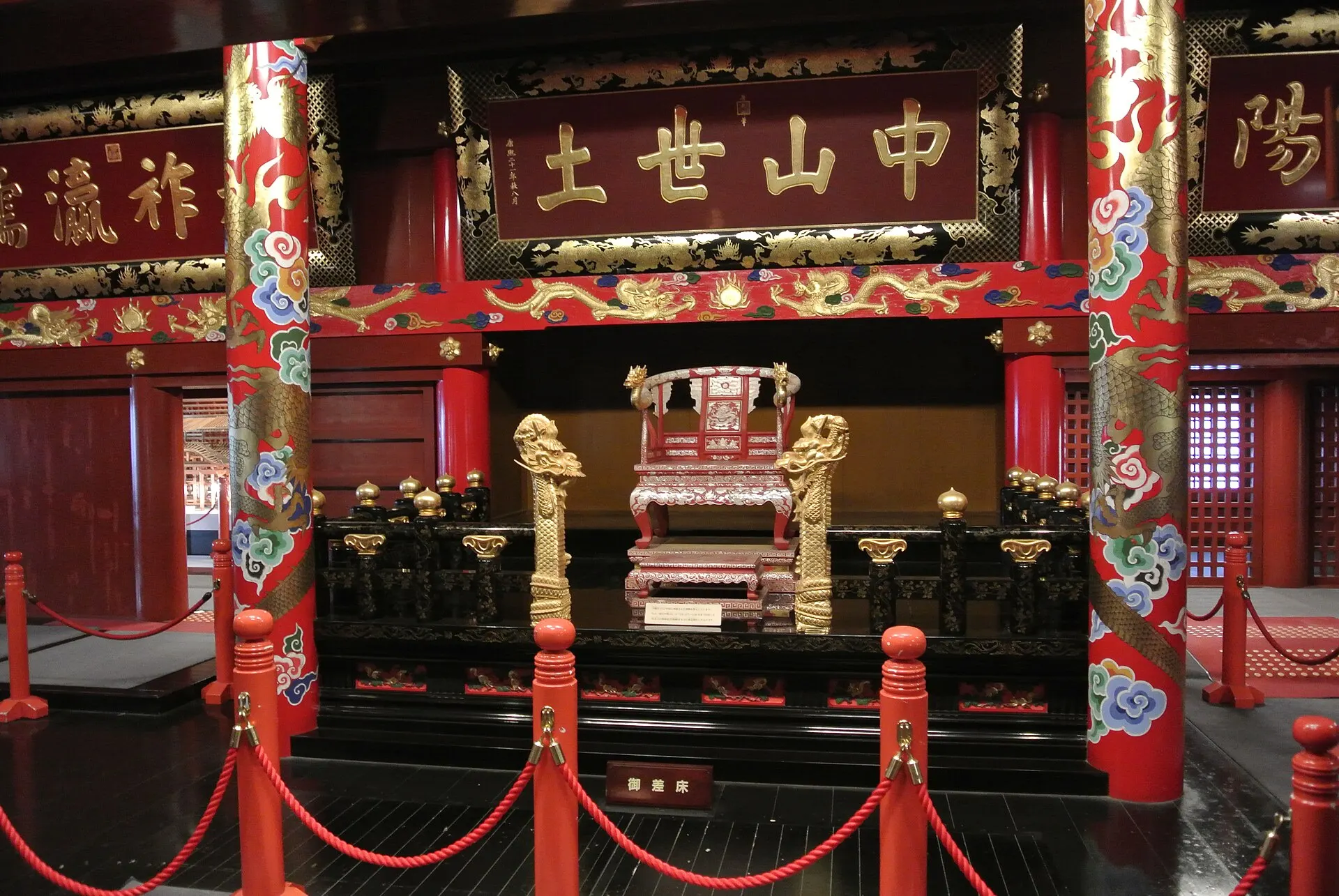
The throne room of the Seiden as reconstructed in 1992, photographed in 2015. The 2026 hall recreates this room.
The fire of 31 October 2019
In the early hours of 31 October 2019 fire broke out in the Seiden, shortly after an event in the courtyard had been packed away. It spread to the North Hall and South Hall and other buildings around the Una, and by the time it was out the heart of the castle was gone. The images of the burning hall on the hill were broadcast across Japan and East Asia and hit Okinawa hard: the 1992 castle had become the island's most visible symbol of its own history.
Investigators were unable to establish a definite cause. The lessons were built into the new hall instead: the reconstructed Seiden has added fire detection, sprinklers, arson-monitoring sensors and seismic reinforcement, according to reporting on the completed building.
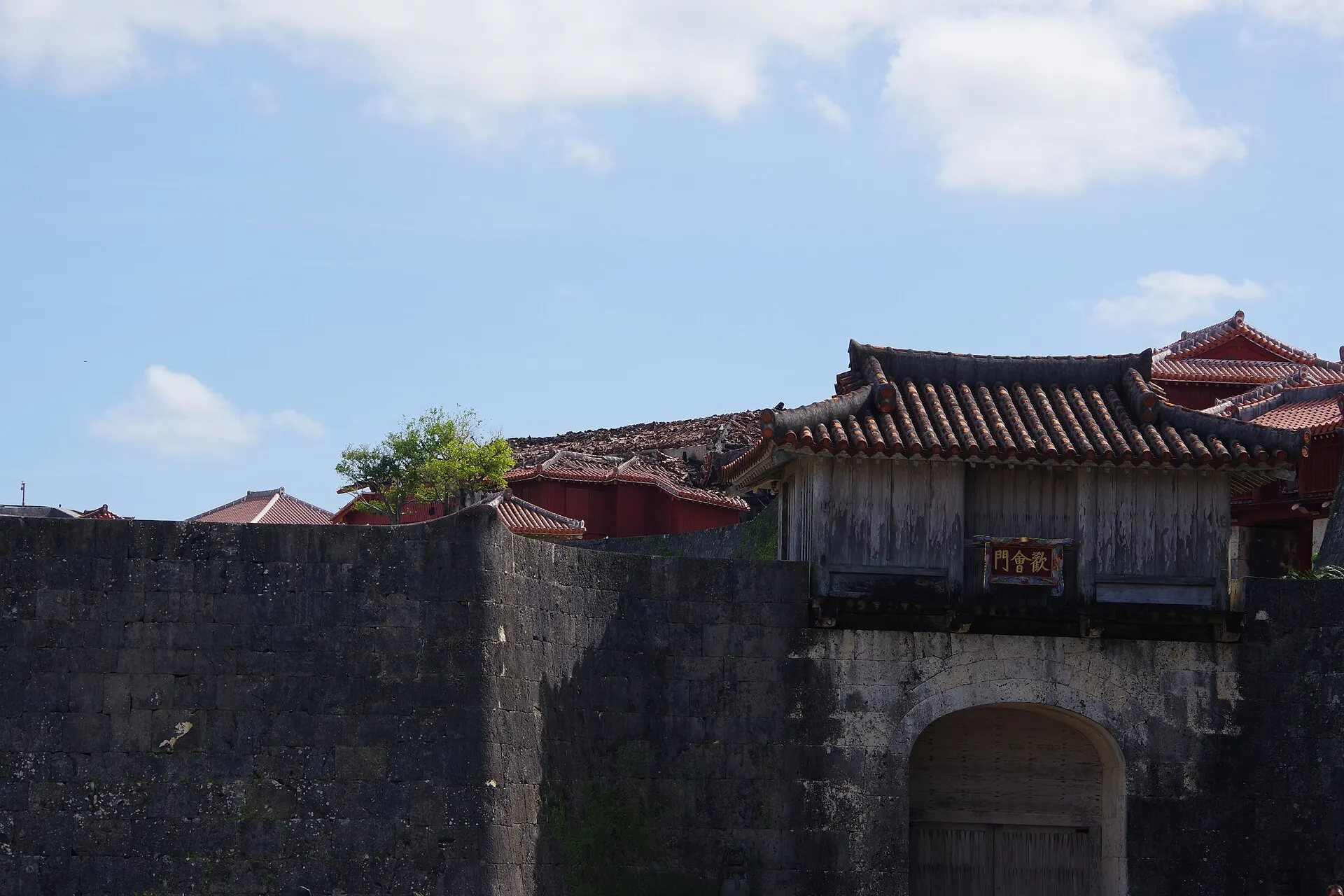
Shuri Castle seen from the Kankaimon gate in November 2019, a few days after the fire.
The Reiwa reconstruction, 2022 to 2026
In March 2020 the national government's ministerial council on the restoration published a timetable: design work from 2020, construction of the Seiden from 2022 and completion in 2026, with the North Hall, South Hall and other buildings to follow. Ground was broken on 3 November 2022, exactly thirty years after the 1992 reopening.
The rebuilding was done in the open. A tall temporary enclosure (sōyane) went up over the site with viewing galleries, so visitors could watch carpenters, roofers and painters at work, and the burned stone foundations of earlier halls were left on view. This approach, called 'mieru fukkō' (reconstruction you can see), turned the castle into a working site that many visitors found more interesting than the finished hall.
Research did not stop with the 1992 version. The 2026 Seiden differs in details: the vermilion lacquer uses Kushima-giri bengara, an iron-oxide red that records say was supplied from Kushi district (today's eastern Nago and part of Higashi village) in north Okinawa, and the carvings over the front steps and the railing of the upper-floor throne balcony were changed after analysis of three Meiji-era photographs donated to the Okinawa Prefectural Archives. Donations from across Japan and abroad helped pay for the work.
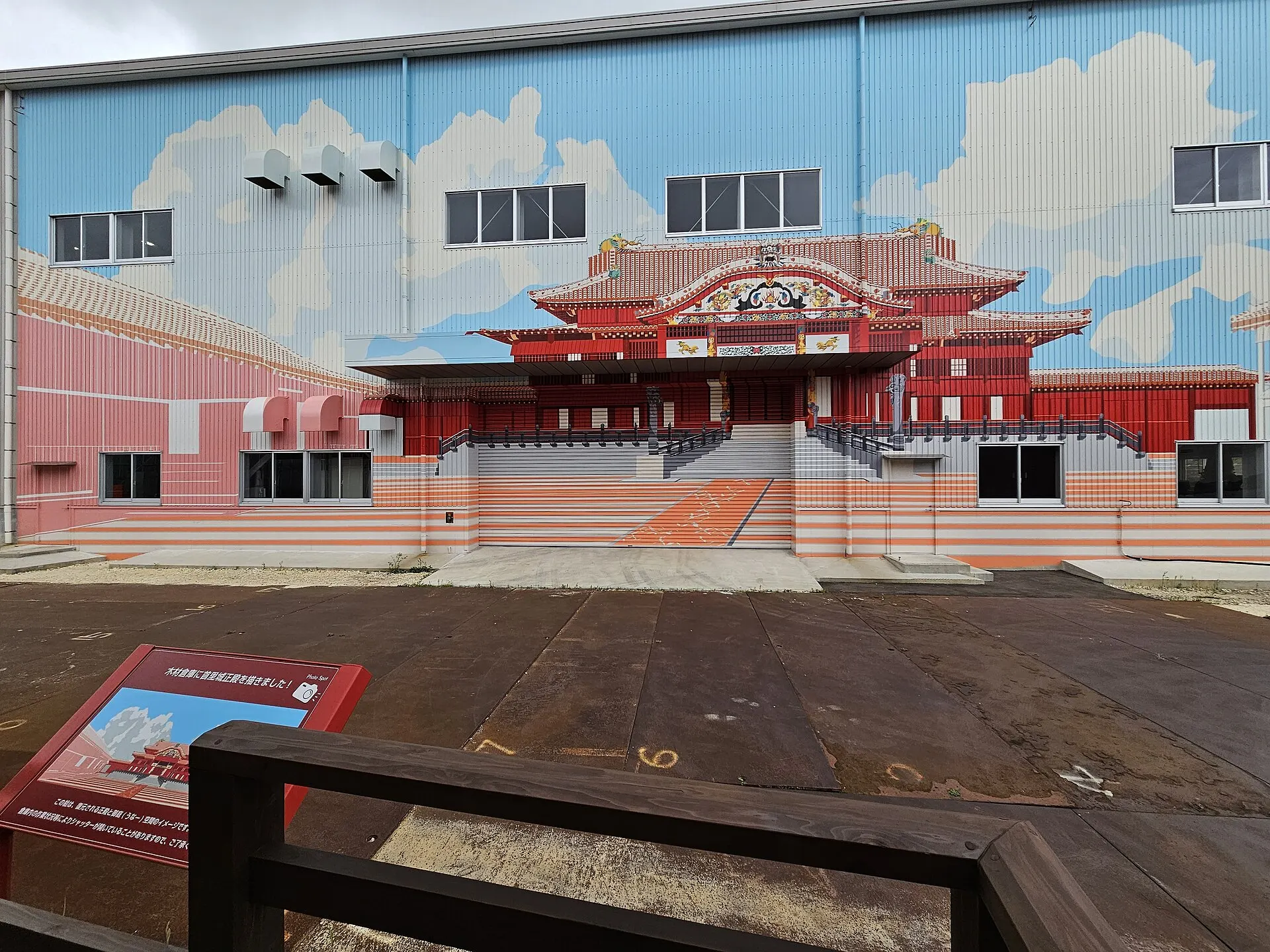
The temporary enclosure over the Seiden during reconstruction, 2023. Visitors could watch the work from inside.
What to see in and around the castle
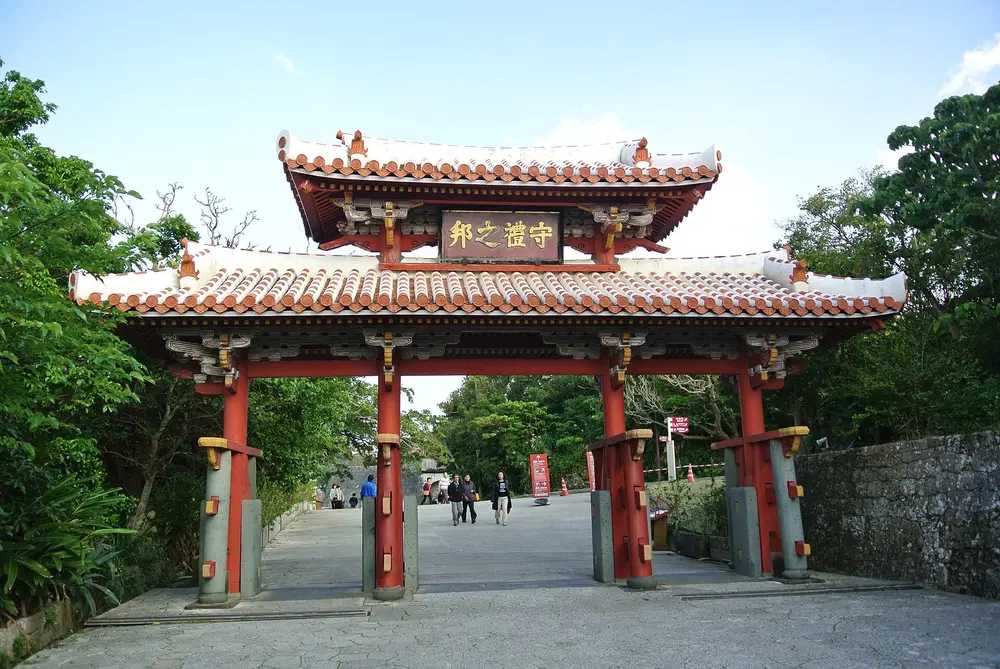
Shureimon, the ornamental gate with the inscription 'Land of Propriety', is the classic first photograph; it was rebuilt in 1958 and appears on the ¥2,000 note. Just beyond it, the Sonohyan-utaki stone gate (1519) is an original structure and a World Heritage component: it was the king's place of prayer before leaving the castle.
Inside the walls, the free route climbs through Kankaimon, Zuisenmon with its spring, and Rōkokumon to the Kōfukumon ticket gate. From the Iri-no-Azana and Agari-no-Azana lookouts you see Naha, the port and, on clear days, the Kerama Islands on the horizon. Kyō-no-uchi, the sacred forest grove inside the walls, was where the chief priestess conducted state rituals.
Outside, the Ryūtan pond below the castle is a calm place to see the walls, and the Shuri Kinjō-chō stone-paved road runs downhill through old residential lanes to the giant Akagi trees. Tamaudun, the royal mausoleum, and Shikinaen, the royal garden, are both World Heritage sites a short ride away; the Naha and Shuri area guide covers them in detail.
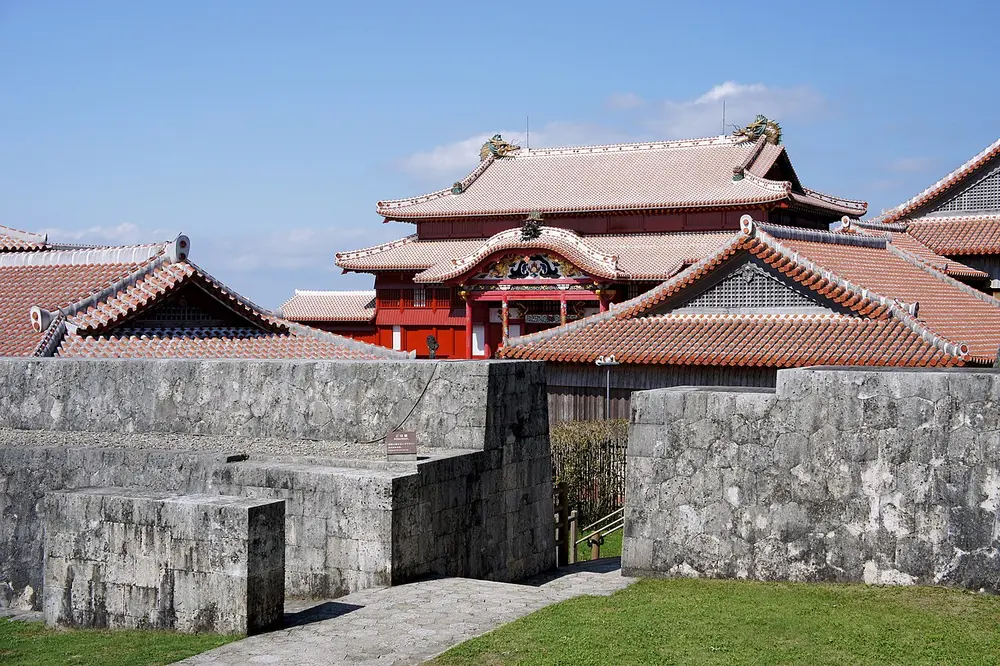
Shurijo Castle and Tamaudun guided tour
A guided tour of two UNESCO sites in Shuri: the royal castle and the royal mausoleum of Tamaudun.
Check availabilityBook via GetYourGuideNaha: 1.5-hour Shurijo Castle tour
A 1.5-hour guided tour of Shuri Castle, the heart of the Ryukyu Kingdom.
Check availabilityBook via GetYourGuideShuri Castle Ryukyu heritage walking tour
A guided walking tour of Shuri Castle and the Ryukyu heritage around it.
Check availabilityBook via GetYourGuideOkinawa: open-top double-decker bus tour to Shuri Castle
Open-top double-decker bus ride to Shuri Castle.
Check availabilityBook via GetYourGuideTour listings are on GetYourGuide. Prices, times and cancellation terms are shown live on each listing and can change; Ryukyu.com may earn a commission at no extra cost to you.
Getting to Shuri Castle
The simplest way is the Yui Rail monorail from Naha Airport or central Naha to Shuri Station, then about 15 minutes on foot (signposted; there is a short climb). Several city buses stop near the castle. There is a paid car park for the park, but it fills on busy days; the monorail is easier. For tickets and IC cards on Yui Rail see getting around Okinawa.
From the cruise terminal or on a short stopover, guided half-day tours that combine the castle with Tamaudun or other royal sites save time, and the open-top double-decker bus tour from Naha includes the castle.
Naha: full-day driving tour with Shurijo Castle
Full-day guided drive around Okinawa including Shurijo Castle.
Check availabilityBook via GetYourGuideNaha private shore excursion: Shuri Castle
A private shore excursion from Naha port for cruise passengers, including Shuri Castle.
Check availabilityBook via GetYourGuideTour listings are on GetYourGuide. Prices, times and cancellation terms are shown live on each listing and can change; Ryukyu.com may earn a commission at no extra cost to you.
Book a Shuri Castle tour
A guide adds a great deal at Shuri: the reconstruction story, the court rituals and the war history under your feet are easy to miss on your own. Note that a tour booking does not automatically include a Seiden interior time slot; check the listing, and book the slot yourself on the official site if it is not included.
Frequently asked questions
Is Shuri Castle open now?
Yes. The castle park has stayed open throughout the rebuilding, and the reconstructed Seiden (main hall) opened to the public on 23 November 2026. The North and South halls are still to be rebuilt (as checked 24 November 2026).
Do I need a reservation for Shuri Castle?
Only for the inside of the Seiden. You book a timed slot online with your entry ticket at no extra charge. The rest of the paid area can be visited with a normal ticket.
How much is the ticket?
¥1,000 for adults, ¥760 for high-school students, ¥370 for primary and junior-high pupils, free under six (official fees as checked November 2026).
When do Seiden tickets go on sale?
On the 1st of each month at 13:00 Japan time, for the month two months ahead. Same-day tickets are sold only if slots remain.
Is Shuri Castle a World Heritage Site?
Its remains are: the original walls and foundations are part of the Gusuku Sites and Related Properties of the Kingdom of Ryukyu, inscribed in 2000. The wooden buildings are modern reconstructions.
What caused the 2019 fire?
The fire started in the Seiden early on 31 October 2019; investigators could not determine a definite cause.
Sources and official information
Facts were checked against these official sources in November 2026. Opening hours, prices and timetables change, so confirm before you go.
- oki-park.jp
- oki-park.jp
- oki-park.jp
- oki-park.jp
- oki-park.jp
- ryukyushimpo.jp
- kantei.go.jp
- www8.cao.go.jp
- nippon.com
- whc.unesco.org
Ryukyu.com is an independent guide, not the official site of any tourism board, government, airline, port or ferry operator. Some links are affiliate links: tours go to GetYourGuide and stays go to Booking.com, and we may earn a commission at no extra cost to you.